


Penetration Testing Companies in Australia: Why Penetration Testing and 24/7 Managed Detection and Response (MDR) Work Better Together
Objective
This article is designed to help Australian organisations understand what to look for when choosing a penetration testing company, and why penetration testing should not be treated as a once-a-year security exercise.
A penetration test can show you where an attacker may find a way into your environment. But once the assessment is complete, your systems continue to change and cyber threats continue to evolve.
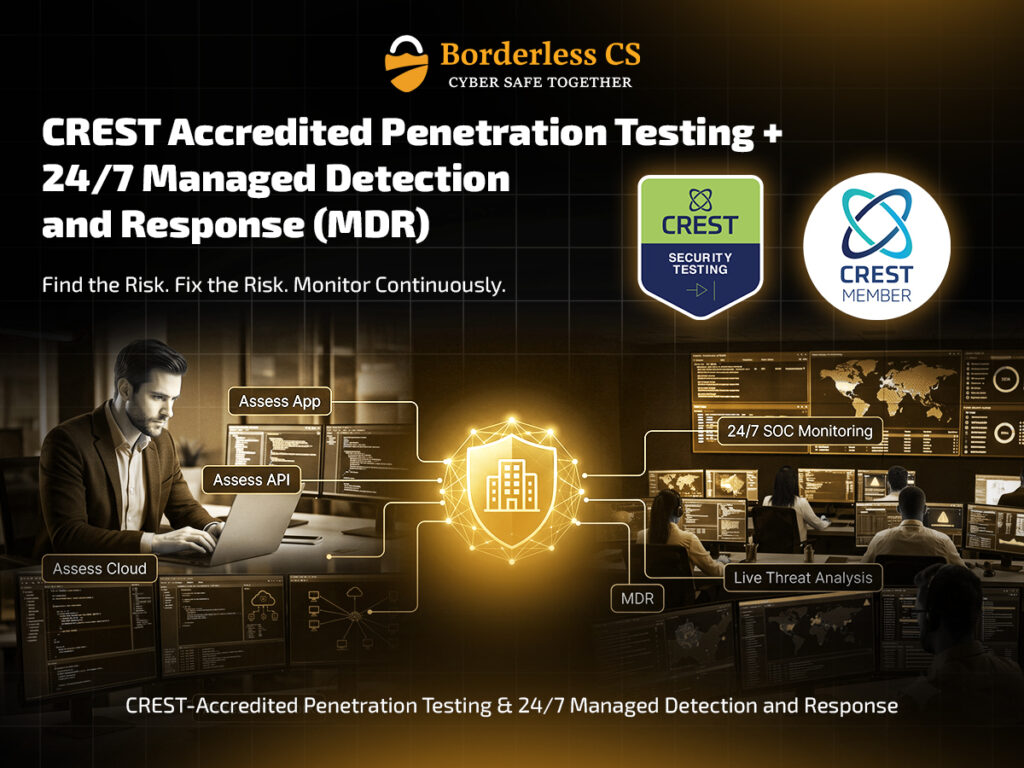
Combining penetration testing with 24/7 Managed Detection and Response (MDR) gives organisations a more complete approach to cybersecurity: identify the risk, understand its impact, remediate the weakness, validate the remediation and continuously monitor for threats.
Key Takeaways
- Penetration testing helps identify exploitable vulnerabilities and realistic attack paths before they are used by attackers.
- A proper penetration test should involve experienced security professionals and human-led testing, not just automated vulnerability scanning.
- When comparing penetration testing companies in Australia, look at accreditation, methodology, technical expertise, reporting, remediation support and retesting.
- Penetration testing gives you a point-in-time assessment; 24/7 Managed Detection and Response (MDR) provides continuous visibility.
- MDR is not simply about generating alerts. It involves monitoring, investigation, escalation and response.
- Penetration testing and MDR work particularly well together because one identifies potential attack paths while the other monitors for suspicious activity.
- Borderless CS brings offensive security, 24/7 MDR/SOC, cyber defence, governance, risk and compliance together under one cybersecurity-focused organisation.
Introduction
There is a question organisations often ask when planning their cybersecurity program:
“If we complete a penetration test every year, is that enough?”
Penetration testing is an important part of a strong cybersecurity program, but it only tells part of the story.
A penetration test can uncover vulnerabilities in your web applications, APIs, networks, cloud infrastructure and other systems. It can show how an attacker might exploit a weakness, gain additional access or reach sensitive information.
But your business does not stand still after the penetration test is finished.
New applications are released. Employees join and leave. Cloud resources are added. Permissions change. Software is updated. New vulnerabilities are discovered.
And attackers do not wait until your next scheduled penetration test.
That is why organisations comparing penetration testing companies in Australia should think beyond a one-off assessment. The stronger approach is to combine proactive, human-led penetration testing with 24/7 Managed Detection and Response (MDR).
Penetration testing helps answer: “Where could an attacker get in?”
MDR helps answer: “Is someone trying to get in right now?”
Together, they provide a much clearer picture of your organisation's cyber risk.
1. What Does a Penetration Testing Company Do?
A penetration testing company assesses your environment from the perspective of an attacker.
The purpose is not simply to produce a long list of vulnerabilities. The real value comes from understanding whether a weakness can actually be exploited, what an attacker could potentially access, and whether several smaller weaknesses could be combined into a more serious attack path.
Depending on the agreed scope, a penetration testing engagement may assess:
- Web applications
- APIs
- Internal networks
- External infrastructure
- Mobile applications
- Cloud environments
- Microsoft 365 and Azure environments
- Authentication and access controls
- Wireless environments
- Security configurations
For example, an automated tool might identify an outdated component. A penetration tester goes further:
- Can the vulnerability actually be exploited?
- What could an attacker do if it were exploited?
- Could it be combined with another security weakness?
- Could it provide access to sensitive information or another system?
- What would the impact be on the business?
This is where experienced, human-led penetration testing adds value.

If your organisation needs to assess the security of an application, API, network or cloud environment, explore our CREST-accredited Penetration Testing Services in Australia.
2. Penetration Testing vs Vulnerability Scanning
Penetration testing and vulnerability scanning are sometimes treated as interchangeable terms. They are not the same thing.
Vulnerability Scanning
Vulnerability scanning primarily uses automated tools to identify potential weaknesses such as:
- Known software vulnerabilities
- Outdated components
- Exposed services
- Missing patches
- Common security misconfigurations
Vulnerability scanning is useful and should form part of an organisation's broader vulnerability-management program. But automated tools have limitations.
Penetration Testing
Penetration testing goes further by investigating vulnerabilities and determining what they mean in a realistic attack scenario.
A penetration tester may investigate issues involving:
- Broken access controls
- Authentication weaknesses
- Privilege escalation
- Business logic flaws
- API authorisation
- Identity and permissions
- Cloud misconfigurations
- Chained vulnerabilities
- Application-specific security weaknesses
| Vulnerability Scanning | Penetration Testing | |
|---|---|---|
| Approach | Primarily automated | Human-led, tool-assisted |
| Output | List of potential weaknesses | Validated findings and attack paths |
| Exploitability | Generally not validated | Investigated and validated |
| Business context | Limited | Impact explained for the organisation |
| Typical use | Ongoing vulnerability management | Point-in-time security assurance |
An automated tool may tell you that something looks vulnerable. An experienced penetration tester investigates what an attacker could actually do with it. That distinction matters.
3. What to Look for in Penetration Testing Companies in Australia
Search for penetration testing companies in Australia and you will find plenty of options. From the outside, many providers appear to offer similar services.
The difference often becomes clearer when you look at how the testing is actually performed, who performs it and what happens after the vulnerabilities are discovered. Here are some important areas to consider.
3.1 Look for Recognised Accreditation
Independent accreditation provides additional assurance when selecting a penetration testing provider.
Borderless CS provides CREST-accredited penetration testing services, with assessments focused on identifying exploitable vulnerabilities and realistic attack paths rather than simply producing automated scanning results.
CREST provides independent accreditation for organisations delivering penetration testing and other cybersecurity services. You can read more about Borderless CS's CREST penetration testing accreditation directly through CREST.
3.2 Ask Whether the Testing Is Human-Led
Automated tools are valuable, but they should support experienced penetration testers rather than replace them.
Real attackers do not simply run one vulnerability scanner and stop when the scan finishes. They investigate. They test permissions. They look for relationships between vulnerabilities. They try to understand how one weakness could provide access to something else.
That same thinking is important during an authorised penetration test.
3.3 Look at Reporting Quality
A penetration testing report needs to be useful after the engagement is finished. For each significant finding, your organisation should be able to understand:
- What was discovered?
- How could it be exploited?
- What is the potential impact?
- How serious is the risk?
- What should we do to fix it?
Technical teams need enough detail to remediate the issue. Executives and other stakeholders need enough context to understand why it matters. Good penetration testing connects the two.
3.4 Ask What Happens After the Report
This is often overlooked. Finding vulnerabilities is only the beginning. The next step is remediation.
Once corrective actions have been implemented, retesting can validate whether the vulnerabilities have actually been resolved.
At Borderless CS, we believe a penetration testing report should not be the end of the engagement. The goal should be to move from finding the risk to fixing the risk.
4. Why Penetration Testing Is Only Part of the Picture
Imagine your organisation completes a penetration test today. Your team receives the report, fixes the important findings and completes the retest. That's a good outcome.
But what happens three months later?
- Perhaps a new application has been deployed.
- An administrator has changed a Microsoft 365 configuration.
- A new employee has been given excessive permissions.
- A software vulnerability has been publicly disclosed.
- Or an employee's credentials have been compromised through phishing.
The penetration test did its job. The environment simply changed.
This is the important point: penetration testing provides point-in-time assurance. Cyber threats are continuous.
Organisations therefore need a way to proactively find security weaknesses while also maintaining visibility over what is happening in their environment after the assessment is complete. That brings us to MDR.
5. What Is 24/7 Managed Detection and Response (MDR)?
Managed Detection and Response (MDR) is a cybersecurity service focused on continuously monitoring an organisation's environment for suspicious or malicious activity, and supporting the response when a genuine threat is identified.
Most organisations already have security technology. They may use endpoint protection, EDR, Microsoft security technologies, firewalls, SIEM platforms and other security controls. These technologies generate alerts.
But generating an alert and responding to a cyber threat are two very different things.
- An employee signs into an account from an unusual location. Is the employee travelling, or have their credentials been compromised?
- An endpoint suddenly executes an unusual PowerShell command. Is it legitimate administration or malicious activity?
- A user account begins accessing an unusual volume of information. Is there a business reason, or could this be an indicator of compromise?
Technology gives you signals. Experienced security analysts help provide the context needed to understand them. That is where MDR becomes valuable.

Learn more about 24/7 Managed Detection and Response (MDR) services from Borderless CS.
6. Why 24/7 Security Monitoring Matters
Cybercriminals do not work according to Australian business hours. An attack can begin overnight. It can happen on a Saturday. It can happen during a public holiday when most of the business is offline.
If a security alert appears at 2:00 AM and nobody investigates it until the next business day, an attacker potentially has hours to continue operating.
Depending on the nature of the compromise, an attacker may attempt to:
- Steal user credentials
- Escalate privileges
- Move laterally between systems
- Access sensitive information
- Establish persistence
- Disable security controls
- Exfiltrate data
- Deploy ransomware
This is why 24/7 monitoring matters. The purpose of MDR is not simply to send more security notifications to your IT team. It is to provide continuous monitoring, investigation, escalation and response capability when suspicious activity occurs.
7. How Penetration Testing and MDR Work Together
Penetration testing and MDR solve two different parts of the same cybersecurity problem.
- Penetration testing: “How could somebody compromise our environment?”
- Managed Detection and Response: “Is somebody trying to compromise our environment right now?”
Consider a penetration test that discovers excessive privileges, weak access controls or an exposed service. The organisation remediates the vulnerability. The issue is retested and confirmed as resolved.
That's excellent — but the organisation's environment will continue changing.
MDR provides the ongoing layer. It continuously monitors the environment for suspicious activity so the organisation is not relying solely on the results of an assessment completed months earlier.
One is proactive testing. The other is continuous detection and response. Together, they provide stronger security visibility.
8. From Assessment to Continuous Cyber Resilience
At Borderless CS, we look at cybersecurity as a connected lifecycle rather than a collection of unrelated security projects.
Assess → Protect → Detect → Respond → Recover → Assure
- Assess
- Identify vulnerabilities, security weaknesses and realistic attack paths through penetration testing and cybersecurity assessments.
- Protect
- Remediate identified weaknesses and strengthen security controls.
- Detect
- Continuously monitor the environment for suspicious and malicious activity.
- Respond
- Investigate potential threats and support containment and incident response.
- Recover
- Restore affected systems and business operations following an incident.
- Assure
- Validate remediation and provide security assurance to executives, customers, auditors and other stakeholders.
This approach means a penetration test does not simply result in a report that sits in a folder until next year. The findings become part of an ongoing security-improvement process.
9. Cybersecurity and Australian Organisations
Cybersecurity is not only a technical concern. For Australian organisations, it is increasingly connected to governance, risk management, customer expectations and regulatory requirements.
The Australian Signals Directorate recommends the Essential Eight as a baseline set of mitigation strategies designed to make it harder for cyber threat actors to compromise systems.
Depending on the organisation and industry, cybersecurity programs may also need to consider frameworks and requirements such as:
- ISO/IEC 27001
- Essential Eight
- SOC 2
- APRA CPS 234
- PCI DSS
- Security governance
- Risk management
- Customer security requirements
- Cyber insurance requirements
Technical cybersecurity and governance therefore need to work together. It is not enough to know that a vulnerability exists. Organisations need to understand what the vulnerability means to the business, how it should be prioritised and how remediation can be demonstrated to stakeholders.
10. Why Borderless CS?
One Cybersecurity Partner. Complete Cyber Resilience.
Borderless CS is an Australian cybersecurity specialist providing end-to-end cybersecurity assurance across offensive security, 24/7 MDR/SOC security operations, cyber defence, governance, risk and compliance.
Our difference is simple. We don't just identify cybersecurity risks. We help organisations understand those risks, remediate weaknesses, validate corrective actions, continuously monitor their environments, respond to threats and demonstrate security assurance.
Cybersecurity-First
Cybersecurity is our core business. Borderless CS is not a general IT or MSP company with cybersecurity added as another service. Our services, people and delivery methodologies are focused specifically on cybersecurity.
Explore our broader cybersecurity services in Australia.
CREST-Accredited Penetration Testing
Our penetration testing capability provides technically rigorous security assessments designed to identify exploitable vulnerabilities and realistic attack paths.
Our penetration testing capabilities include:
- Web Application Penetration Testing
- API Penetration Testing
- Internal Network Penetration Testing
- External Network Penetration Testing
- Mobile Application Penetration Testing
- Cloud Penetration Testing
- Microsoft 365 and Azure Security Assessments
- Wireless Penetration Testing
Learn more about our Penetration Testing Services in Australia.
Human-Led Offensive Security
Technology is important, but experienced security professionals remain at the centre of our penetration testing approach. Our focus is on understanding how vulnerabilities could be exploited in a real-world scenario and what those vulnerabilities mean to the organisation.
24/7 MDR + SOC
Cybersecurity does not finish when a penetration test is completed. Borderless CS can continue supporting organisations through 24/7 Managed Detection and Response and SOC services, providing continuous security monitoring, threat detection, investigation, escalation and incident-response support.
Cybersecurity + Governance and Compliance
Technical security needs to connect with business assurance. Borderless CS supports organisations across cybersecurity and areas including ISO/IEC 27001, Essential Eight, SOC 2, security governance, risk management and compliance.
This helps organisations translate technical security findings into risks that executives, auditors, customers and other stakeholders can understand.
Independent and Vendor-Neutral
Good cybersecurity advice should be driven by risk and business requirements. Our approach is vendor-neutral, helping organisations make informed security decisions across people, processes and technology.
11. Do You Need Penetration Testing, MDR or Both?
It depends on what you are trying to achieve.
You May Need Penetration Testing If:
You need to understand whether your applications, APIs, internal network, external infrastructure or cloud environment contain exploitable security weaknesses.
You May Need MDR If:
You already have security controls and technology in place but need continuous monitoring, investigation and response capability.
You May Need Both If:
You want to proactively identify security weaknesses while continuously monitoring for suspicious and malicious activity.
The relationship between the two is simple:
Penetration testing finds the gaps. MDR watches for somebody trying to get through them.
For organisations looking for a more complete cybersecurity approach, combining the two provides both proactive assurance and continuous visibility.
From Finding Risk to Building Cyber Resilience
When comparing penetration testing companies in Australia, don't make the decision based only on the number of testing days or the price at the bottom of a proposal. Ask what happens before, during and after the assessment.
- Is the provider independently accredited?
- Is the testing human-led?
- Will the findings be explained in a way your business can understand?
- Will you receive practical remediation guidance?
- Can the remediation be validated?
- And once the penetration test is complete, who is watching your environment?
At Borderless CS, our approach covers the complete cyber-risk lifecycle:
Identify the risk → Understand the business impact → Remediate the weakness → Validate the remediation → Monitor continuously → Respond to threats → Demonstrate cyber assurance.
That is how penetration testing becomes more than an annual security exercise. It becomes part of a broader strategy for building cyber resilience.
Ready to Strengthen Your Cybersecurity?
Whether you're currently comparing penetration testing companies in Australia, looking for 24/7 Managed Detection and Response, or need both, Borderless CS can help you determine the right approach for your organisation.
Talk to our team about your environment, security concerns and business requirements.
Contact Borderless CS to discuss your penetration testing or 24/7 MDR requirements.
Frequently Asked Questions
What is penetration testing?
Penetration testing is an authorised security assessment that simulates realistic attack techniques to identify vulnerabilities and understand how those weaknesses could potentially be exploited.
How do I choose a penetration testing company in Australia?
Look beyond price alone. Consider recognised accreditation, technical expertise, the level of human-led testing, methodology, reporting quality, remediation support and retesting.
Is penetration testing the same as vulnerability scanning?
No. Vulnerability scanning primarily uses automated technology to identify potential security weaknesses. Penetration testing goes further by investigating those vulnerabilities, validating exploitability and identifying realistic attack paths.
How often should penetration testing be performed?
There is no single schedule that works for every organisation. Penetration testing may be performed regularly and after significant changes such as major application releases, infrastructure changes, cloud migrations or changes to critical systems.
What is 24/7 Managed Detection and Response?
24/7 Managed Detection and Response provides continuous security monitoring, threat detection, investigation, escalation and response support. It helps organisations identify and respond to suspicious or malicious activity as it occurs.
Why does an organisation need 24/7 MDR?
Security incidents can happen outside normal business hours. MDR provides continuous monitoring so potentially malicious activity can be investigated rather than waiting for somebody to review an alert the following business day.
What is the difference between MDR and a SOC?
A Security Operations Centre (SOC) provides the people, processes and technology used to monitor and investigate security activity. MDR is a managed cybersecurity service focused on providing detection, investigation and response capabilities for an organisation.
Can penetration testing and MDR work together?
Yes. They address different parts of cybersecurity. Penetration testing proactively identifies exploitable weaknesses, while MDR continuously monitors for suspicious and malicious activity. Together, they provide proactive security testing and ongoing threat detection and response.