


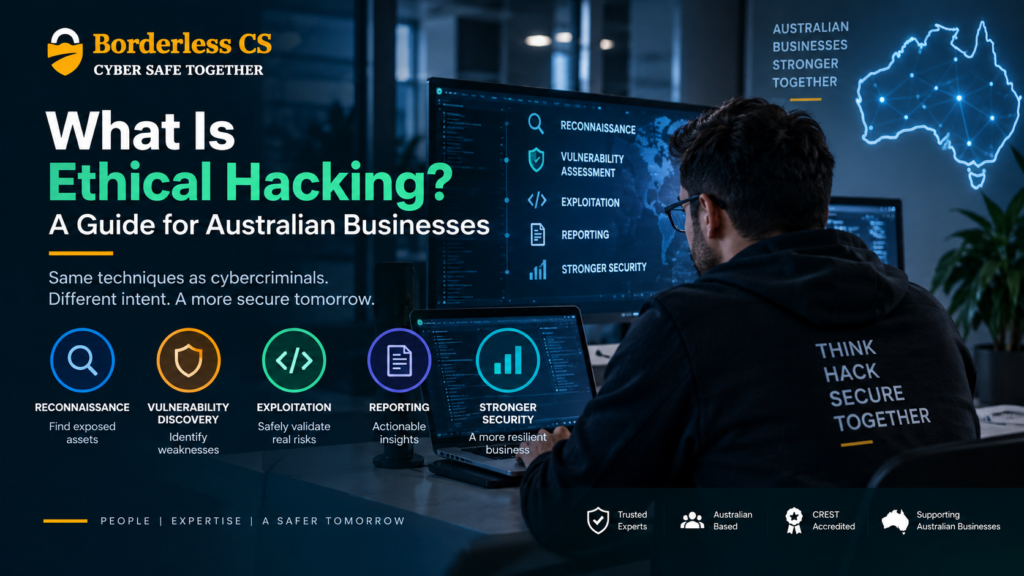
What Is Ethical Hacking? A Guide for Australian Businesses
Quick answer: Ethical hacking is the practice of using the same tools and techniques as cybercriminals, but with permission, to find security weaknesses before attackers do. Ethical hackers work under a defined scope and legal agreement, then report what they found so your organisation can fix it. It’s the umbrella term that covers penetration testing, vulnerability research, and other authorised attack simulations.
If you’ve come across the term while researching how to protect your business, you’re not alone “ethical hacking” gets used interchangeably with a handful of other security terms, and the differences matter when you’re deciding what your organisation needs.
Ethical Hacking vs Hacking: What's the Difference?
The technique is identical. The difference is permission, scope and intent.
A malicious hacker breaks in without authorisation, for personal gain or disruption. An ethical hacker sometimes called a “white hat” operates under a signed agreement that defines exactly what can be tested, when, and how. Everything is documented, nothing is exploited beyond what’s needed to prove a risk, and the findings go straight to the organisation, not onto the dark web.
This is why ethical hacking engagements always start with a scope and rules of engagement before any testing begins.
What Do Ethical Hackers Actually Do?
Ethical hacking covers a range of techniques, chosen based on what’s being tested:
- Reconnaissance — mapping what’s publicly visible about your organisation, the same way an attacker would before choosing a target
- Vulnerability discovery — identifying weaknesses in systems, applications, configurations or human behaviour
- Exploitation — safely demonstrating whether a weakness can be used to gain access, not just theoretically exists
- Reporting — translating findings into business risk, not just a technical list
Penetration testing is the most common form of structured ethical hacking, where a tester works through this full process against a defined target a website, network, or application under a formal agreement. If you want the detail on how that specific process works, see our full penetration testing services guide.
Why Australian Businesses Are Investing in Ethical Hacking
Australia’s threat landscape has shifted the conversation from “should we do this” to “how often.” A few drivers show up in almost every conversation we have with clients:
- Rising attack volume — ransomware, phishing and credential theft attempts against Australian organisations have climbed steadily, and small-to-medium businesses are no longer considered “too small to target”
- Compliance pressure — frameworks like the Essential Eight, ISO 27001 and APRA CPS 234 increasingly expect organisations to demonstrate their security controls actually hold up under attack, not just exist on paper
- Insurance and procurement — cyber insurers and enterprise customers are asking for evidence of independent security testing before renewing policies or signing contracts
- Real-world validation — firewalls, antivirus and cloud security settings can all be configured correctly and still fail against a determined attacker. Ethical hacking is the only way to find out before an incident does
Types of Ethical Hackers
You’ll come across three broad categories when researching this:
- White hat — authorised, works for or on behalf of the organisation being tested
- Black hat — unauthorised, malicious intent
- Grey hat — operates without formal authorisation but without malicious intent, often disclosing findings unprompted; not something a business should rely on as a security strategy, since there’s no contract, no scope, and no guarantee of confidentiality
Only formally engaged, white hat ethical hacking gives you a legal agreement, a defined scope, and someone accountable for how your data is handled during testing.
What Certifications Do Ethical Hackers Hold?
Not all “ethical hackers” are equal, and certification is one of the few ways to verify skill and standards before you engage someone:
- CEH (Certified Ethical Hacker) broad foundational certification
- OSCP (Offensive Security Certified Professional) hands-on, exploitation-focused, widely respected
- CREST accreditation held at the company level, not just individual, and one of the few standards Australian government agencies, banks and large enterprises specifically look for when selecting a provider
When you’re evaluating who to trust with access to your systems, ask which certifications the actual consultants hold not just what the company claims on its homepage.
Choosing a Provider: Ethical Hacking Firms vs Freelancers
Once a business decides to move forward, the next question is usually who to engage. This is where it’s worth understanding the market a little:
- Independent penetration testing companies: dedicated firms whose sole focus is offensive security testing, typically CREST-accredited and staffed by employed, security-vetted consultants rather than subcontractors
- Full-service cybersecurity providers (like Borderless CS): who combine ethical hacking with broader managed security, so findings feed directly into ongoing monitoring rather than sitting in a PDF
- Freelance testers: can be cost-effective for small, narrowly scoped work, but rarely carry the same accreditation, insurance or reporting standards as an established penetration testing firm
Not every provider operates to the same standard, so it’s worth asking a handful of Australia’s penetration testing companies the same set of questions: are your testers employees or subcontractors? Is your firm CREST accredited? Does the engagement include retesting? A credible provider will answer all of these without hesitation.
Our Australian-based consultants across Melbourne, Sydney and Brisbane are dual CREST-accredited (ANZ and International) and can walk you through exactly what a scoped engagement would look like for your organisation.
Why Choose Borderless CS
- Dual CREST-accredited (ANZ and International) — one of the few certifications Australian government agencies, banks and large enterprises specifically look for when selecting a provider
- Employed, security-vetted consultants — not subcontractors, so the person testing your systems has been through the same accountability standards as the firm itself
- Australian-based, across Melbourne, Sydney and Brisbane — no offshore delivery, and consultants who understand Australian compliance context (Essential Eight, ISO 27001, APRA CPS 234) first-hand
- Full-service, not a one-off engagement — findings from ethical hacking feed directly into our broader managed security and GRC services, so results turn into an ongoing security posture rather than sitting in a PDF
- Retesting and a Letter of Attestation included as standard — not billed as an afterthought once the report lands
If you’re comparing providers, ask us the same questions we’d suggest asking anyone else — we’ll answer all of them without hesitation.
Build a Strong Cybersecurity Strategy Today
Cyber threats are evolving, targeting businesses of every size. Combining:
- Managed Security Services
- Penetration Testing
- SOC Monitoring
- Cloud Security
creates a resilient cybersecurity strategy. Protect your business, maintain regulatory compliance, and secure your future with Borderless CS.
This article was reviewed by cybersecurity professionals experienced in penetration testing, compliance frameworks, and Australian cyber security regulations.
Frequently Asked Questions
1. Is ethical hacking legal in Australia?
Yes, provided it’s conducted with explicit written authorisation from the system owner, within an agreed scope. Testing without permission even with good intentions can breach the Criminal Code Act and state cybercrime legislation.
2. Is ethical hacking the same as penetration testing?
Not quite penetration testing is one specific, structured form of ethical hacking. Ethical hacking is the broader practice; penetration testing is a defined engagement with a set scope, methodology and report.
3. How much does ethical hacking cost?
Cost depends entirely on the type of engagement, scope and depth required a broad ethical hacking assessment differs significantly in price from a narrowly scoped test. Get in touch for a scoped quote based on your environment.
4. Do small businesses need ethical hacking?
Increasingly, yes attackers don’t discriminate by company size, and many SME cyber insurance policies and customer contracts now expect some form of independent security testing.
Not sure where to start, or want to understand what ethical hacking would look like for your organisation? Book a free 30-minute consultation with Borderless CS.