


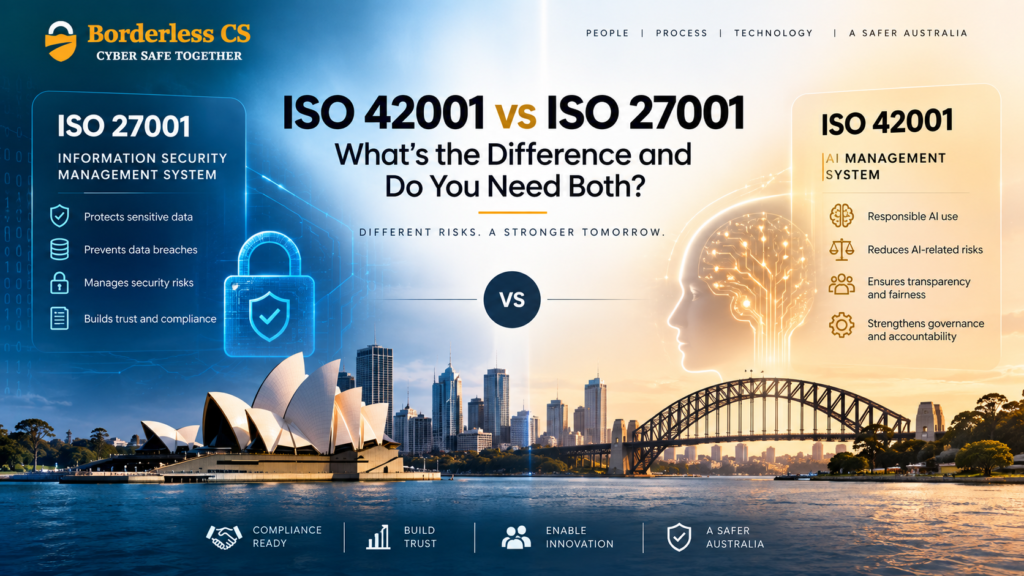
ISO 42001 vs ISO 27001: What’s the Difference and Do You Need Both?
As artificial intelligence becomes part of everyday business operations, Australian organisations are facing a new question: Is ISO 27001 enough, or do we also need ISO 42001?
The two standards are closely related, but they address different risks.
ISO/IEC 27001:2022 provides a framework for establishing and maintaining an Information Security Management System (ISMS). Its focus is protecting information against threats such as unauthorised access, data breaches and other information security risks.
ISO/IEC 42001:2023, on the other hand, focuses specifically on the responsible management of artificial intelligence through an AI Management System (AIMS).
For organisations that use AI alongside sensitive or business-critical information, the two standards can work together rather than replace one another.
This guide explains ISO 42001 vs ISO 27001, where the standards overlap, their key differences, and when an Australian organisation may consider implementing one or both.
ISO 42001 vs ISO 27001 at a Glance
| Area | ISO/IEC 27001:2022 | ISO/IEC 42001:2023 |
|---|---|---|
| Management System | Information Security Management System (ISMS) | AI Management System (AIMS) |
| Primary Focus | Information security | Responsible AI management |
| Key Risks | Data breaches, unauthorised access and information security threats | AI-related risks, transparency, accountability, bias and oversight |
| Relevant To | Organisations managing valuable or sensitive information | Organisations developing, providing or using AI systems |
| Approach | Risk-based information security management | Risk-based AI governance and management |
| Current Version | ISO/IEC 27001:2022 | ISO/IEC 42001:2023 |
ISO 27001 helps organisations protect information. ISO 42001 helps organisations manage AI responsibly.
They can complement each other, particularly where AI systems process sensitive, personal or commercially important information.
What Is ISO 27001?
ISO/IEC 27001 is an internationally recognised standard for information security management.
It provides the requirements for establishing, implementing, maintaining and continually improving an Information Security Management System (ISMS).
An ISMS helps an organisation identify information security risks and put appropriate controls in place to manage them.
Depending on the organisation and its risk environment, this can include areas such as:
- Access control
- Identity and authentication
- Information classification
- Cryptography
- Supplier security
- Incident management
- Vulnerability management
- Business continuity
- Security monitoring
- Risk assessment and treatment
For Australian businesses handling customer information, intellectual property, financial records, health information or other sensitive data, ISO 27001 can provide a structured framework for managing information security risk.
What Is ISO 42001?
ISO/IEC 42001:2023 is an international management system standard designed specifically for artificial intelligence.
It provides requirements for establishing, implementing, maintaining and continually improving an AI Management System (AIMS).
Rather than concentrating primarily on information security, ISO 42001 looks at how AI is governed throughout its lifecycle.
This can include areas such as:
- AI governance and accountability
- AI risk management
- Human oversight
- Transparency
- Responsible use of AI
- AI system impact assessments
- Data used by AI systems
- Monitoring AI performance
- Managing third-party AI systems
- Continual improvement
For organisations developing AI products or integrating AI into important business processes, ISO 42001 provides a structured approach to managing the risks and responsibilities associated with those systems.
ISO 42001 vs ISO 27001: What Is the Main Difference?
The biggest difference is what each management system is designed to manage.
ISO 27001 is centred around information security.
It asks questions such as:
How is sensitive information protected? Who can access it? What happens if a security incident occurs?
ISO 42001 is centred around AI governance.
It raises different questions:
How is an AI system being used? What risks could it introduce? Who is accountable for its decisions or outputs? Is appropriate human oversight in place?
Consider an Australian health technology company using AI to assist with patient enquiries.
ISO 27001 may address how patient information is stored, encrypted and accessed.
ISO 42001 may address how the AI system is governed, how its impact is assessed, how outputs are monitored and where human oversight is required.
Both are important considerations, but they solve different problems.
Where Do ISO 27001 and ISO 42001 Overlap?
One reason organisations may choose to implement both standards is that they share familiar management-system principles.
Both require organisations to consider areas such as:
- Organisational context
- Leadership
- Planning
- Risk management
- Resources and competence
- Documented information
- Operational controls
- Performance evaluation
- Internal audits
- Management reviews
- Continual improvement
This can make ISO 42001 implementation more familiar for organisations that already maintain an ISO 27001-certified ISMS.
Existing governance processes may also provide a useful foundation for developing an AIMS, although the AI-specific risks, controls and responsibilities still need to be addressed separately.
Do You Need ISO 27001 or ISO 42001?
The answer depends on your organisation, customers, contractual requirements, regulatory environment and how technology is being used.
Consider ISO 27001 if:
Your organisation stores, processes or manages sensitive or business-critical information.
It may also be relevant when customers, partners or procurement teams expect evidence of a structured information security management program.
ISO 27001 is particularly relevant where information security and cyber risk are major business considerations.
Consider ISO 42001 if:
Your organisation develops, provides or uses AI systems and needs a structured framework for managing AI-related risks.
It may become particularly relevant where AI influences important processes or decisions involving customers, employees or other stakeholders.
Organisations may also consider ISO 42001 when enterprise customers or procurement teams begin requesting stronger evidence of AI governance.
Consider both if:
Your organisation is both data-sensitive and AI-driven.
For example, a fintech, healthtech, SaaS or technology provider may need strong information security controls while also demonstrating that its AI systems are being managed responsibly.
In this situation, ISO 27001 and ISO 42001 can form complementary parts of a broader governance and risk-management framework.
A Practical ISO 27001 and ISO 42001 Example
Imagine an Australian healthtech company that already maintains an ISO 27001-certified ISMS.
The company introduces an AI system to help triage incoming patient enquiries.
Its existing ISMS may already address:
- Access to patient information
- Encryption
- Authentication
- Logging
- Incident management
- Supplier security
But introducing AI creates additional governance questions.
For example:
- What is the intended purpose of the AI system?
- What risks could the system create?
- How are its outputs monitored?
- What level of human oversight is required?
- Who is accountable for the AI system?
- How are potential impacts assessed?
- What happens when the system produces an incorrect or inappropriate result?
These are the kinds of AI-management considerations that ISO 42001 is designed to address.
The two management systems therefore perform different but complementary roles.
ISO 42001 and ISO 27001 in Australia
Australian organisations are paying increasing attention to both cybersecurity and responsible AI governance.
Businesses using AI still need to consider their existing legal, contractual and industry obligations.
Depending on the organisation and its activities, relevant requirements may include privacy, consumer protection, cybersecurity and sector-specific obligations.
Against this backdrop, internationally recognised management system standards can provide organisations with structured frameworks for demonstrating how risks are identified, governed, monitored and continually improved.
ISO 27001 provides this structure for information security management, while ISO 42001 extends structured management-system thinking into artificial intelligence.
For organisations supplying services to enterprise or government customers, these standards may also support conversations around assurance, procurement and third-party risk management.
Can You Integrate ISO 42001 With ISO 27001?
Yes.
Organisations that already have an established ISMS may be able to reuse or extend parts of their existing management-system framework when implementing an AIMS.
For example, existing processes around:
- Risk management
- Internal audits
- Management reviews
- Document control
- Corrective actions
- Training
- Governance
- Continual improvement
may provide a useful starting point.
However, ISO 42001 still requires an organisation to address AI-specific considerations.
The goal should not simply be to add AI terminology to existing ISO 27001 documentation. The organisation needs to understand its AI systems, their intended use, associated risks, impacts and governance requirements.
Benefits of Implementing ISO 27001 and ISO 42001 Together
For organisations where both standards are relevant, an integrated approach can reduce unnecessary duplication.
Rather than maintaining completely separate management systems, organisations may be able to align common governance processes while maintaining the specific requirements of each standard.
Potential benefits include:
- More consistent risk management
- Clearer governance responsibilities
- Reduced duplication of documentation
- Better alignment between cybersecurity and AI governance
- More efficient internal audit and management review processes
- Stronger customer and stakeholder assurance
The right implementation approach will depend on the maturity, complexity and scope of the organisation.
Why Choose Borderless CS for ISO 27001 and ISO 42001?
Implementing an ISO management system should be about more than producing documents for an audit.
At Borderless CS, we help Australian organisations translate ISO requirements into practical governance, risk and security processes that work within their existing business environment.
Our approach brings together cybersecurity, compliance and technical security expertise, helping organisations address the broader risk environment rather than treating certification as an isolated exercise.
Australian-Based Expertise
Our team understands the Australian cybersecurity, privacy and regulatory environment and works with organisations to develop practical management systems aligned with their operations.
ISO 27001 and ISO 42001 Experience
We support organisations across information security and AI governance, allowing businesses considering both standards to take a more coordinated approach.
Experience From Our Own ISO 42001 Journey
Borderless CS has undertaken the ISO/IEC 42001 certification process for its own AI Management System.
That gives our team practical experience with the implementation and certification journey, not simply theoretical knowledge of the standard.
Cybersecurity and Technical Assurance
Our broader cybersecurity capabilities allow governance and compliance work to connect with practical security activities such as penetration testing, vulnerability management and security assessments where required.
Practical Implementation
Our focus is on building processes that teams can actually maintain after certification.
The objective is not simply to prepare for an audit, but to establish a management system that continues to support the organisation as its technology, risks and business requirements evolve.
Contact Borderless CS:
- Book a Free Scoping Call
- Request a Proposal
- Download Borderless CS’s Penetration Testing Brochure
Build a Strong Cybersecurity Strategy Today
Cyber threats are evolving, targeting businesses of every size. Combining:
- Managed Security Services
- Penetration Testing
- SOC Monitoring
- Cloud Security
creates a resilient cybersecurity strategy. Protect your business, maintain regulatory compliance, and secure your future with Borderless CS.
This article was reviewed by cybersecurity professionals experienced in penetration testing, compliance frameworks, and Australian cyber security regulations.
Frequently Asked Questions
1. Is ISO 42001 a replacement for ISO 27001?
No. ISO 42001 and ISO 27001 address different areas.
ISO 27001 focuses on information security management, while ISO 42001 focuses on AI management and governance. An organisation may choose to implement both where information security and AI-related risks are relevant.
2. Do I need ISO 27001 before ISO 42001?
Not necessarily.
ISO 42001 can be implemented as its own management system. However, organisations with an established ISO management system may already have processes that can provide a useful foundation for implementation.
3. What is the difference between an ISMS and an AIMS?
An ISMS (Information Security Management System) provides a structured framework for managing information security risks.
An AIMS (AI Management System) provides a structured framework for managing risks, responsibilities and governance associated with artificial intelligence.
4. Is ISO 42001 mandatory in Australia?
ISO 42001 is a voluntary international management system standard rather than an Australian law requiring every organisation using AI to become certified.
However, organisations should separately assess the laws, regulations, contractual requirements and industry obligations that apply to their particular use of AI.
5. Can ISO 42001 and ISO 27001 be implemented together?
Yes. Because both are management system standards, organisations may be able to integrate common processes such as risk management, internal audits, management reviews and continual improvement while maintaining the requirements specific to each standard.
6. Which certification should my organisation consider first?
That depends on your risk environment and business requirements.
If information security is the primary requirement, ISO 27001 may be the logical starting point.
If your organisation develops or extensively uses AI, ISO 42001 may also be relevant.
For organisations where AI processes sensitive information or supports important business decisions, considering both standards together may make sense.
7. Build a Stronger Security and AI Governance Framework
AI governance and information security are increasingly connected, but they are not the same thing.
ISO 27001 provides a framework for protecting information. ISO 42001 provides a framework for managing artificial intelligence responsibly.
For organisations using AI alongside sensitive or business-critical information, implementing both standards can provide a more comprehensive approach to governance and risk management.
Borderless CS can help you assess your current environment, identify gaps and determine an appropriate pathway towards ISO 27001 certification, ISO 42001 certification, or an integrated approach to both.
Speak with Borderless CS about ISO 27001 and ISO 42001 readiness and certification support.