


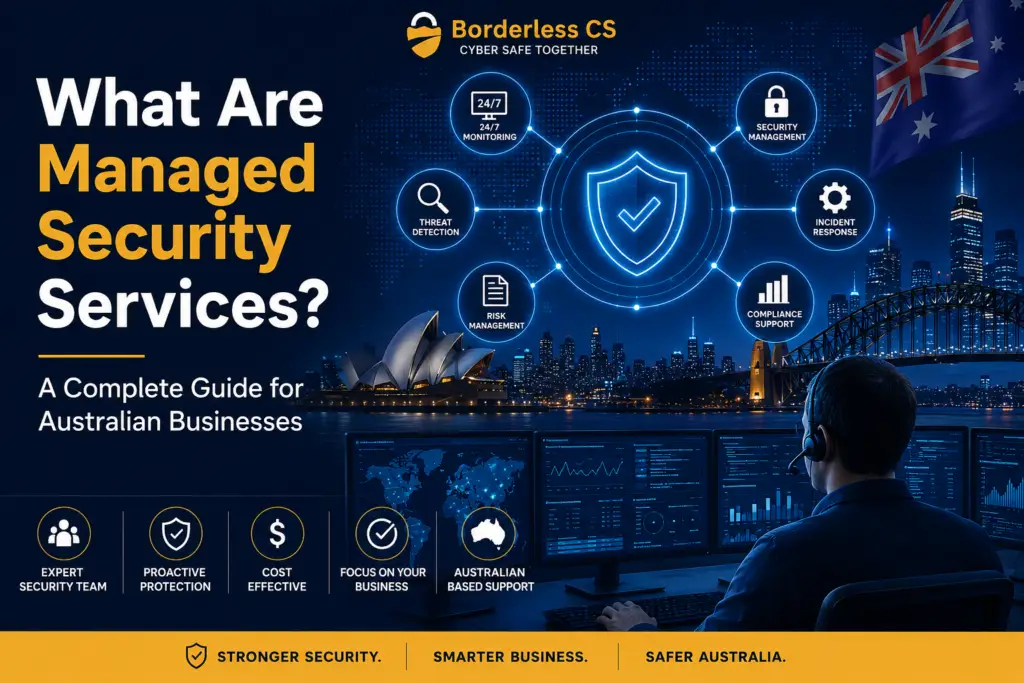
What Are Managed Security Services? A Complete Guide for Australian Businesses
Objective
The objective of this cluster topic is to explain what Managed Security Services are, how a Managed Security Service Provider protects Australian businesses, and why more organisations are using MSSP Australia solutions to strengthen their cybersecurity strategy.
You’ll also learn how Managed Security Services support penetration testing, Microsoft 365 security, endpoint protection, email security, and ISO 27001 compliance as part of a wider cybersecurity program.
Key Takeaways
- Managed Security Services provide continuous monitoring, threat detection, and incident response.
- An MSSP Australia gives businesses access to experienced cybersecurity professionals without building a full in-house Security Operations Centre.
- Managed Security Services work alongside penetration testing, cloud security, endpoint protection, and governance rather than replacing them.
- Choosing the right provider depends on expertise, monitoring capability, reporting quality, and response processes.
- Continuous monitoring helps organisations detect suspicious activity sooner and respond more effectively.
Introduction
Cyber threats don’t stop when your employees finish work for the day.
A suspicious login at midnight, a phishing email sent early in the morning, or malware spreading across connected devices can happen at any time.
If nobody is monitoring your systems when these events occur, small security issues can quickly become expensive business problems.
According to the Australian Signals Directorate (ASD), cybercrime continues to affect thousands of Australian organisations each year, with one cybercrime report made approximately every six minutes. At the same time, many businesses struggle to recruit experienced cybersecurity professionals to monitor threats around the clock.
This is where Managed Security Services can make a real difference.
Instead of relying only on an internal IT team, businesses can work with a Managed Security Service Provider (MSSP) that continuously monitors their environment, investigates suspicious activity, and helps reduce cyber risk before incidents become major disruptions.
Whether you operate a growing business, a government agency, or a large enterprise, understanding how Managed Security Services work will help you make better security decisions.
Table of Contents
| Section | What You’ll Learn |
| What Are Managed Security Services? | Understanding the basics |
| Why Australian Businesses Use Them | Current cybersecurity challenges |
| What an MSSP Does | Core services and responsibilities |
| Benefits of Managed Security Services | Business and security advantages |
| How to Choose an MSSP Australia | Questions to ask providers |
| Conclusion & FAQs | Key takeaways and next steps |
What Are Managed Security Services?
A Managed Security Service is a contracted third-party cyber-security service that will monitor, identify, assess, and act against security threats to its clients. Rather than relying on the internal IT department to address every single security issue, organisations contract a Managed Security Service Provider that will defend digital spaces. Consider it like a security team that is monitoring for threats 24/7. While your employees concentrate on running the business, security analysts monitor suspicious activity, investigate alerts, and help reduce cyber risks before they affect daily operations.
Depending on your organisation’s needs, Managed Security Services may include:
- 24/7 security monitoring
- Threat detection
- Incident investigation
- Security alert management
- Endpoint monitoring
- Cloud security monitoring
- Microsoft 365 security monitoring
- Security reporting
- Threat intelligence
- Vulnerability management
The exact services vary between providers, but the goal remains the same, help organisations identify and respond to cyber threats as quickly as possible.
Why Australian Businesses Are Choosing Managed Security Services
Cybersecurity has changed significantly over the past few years.
Businesses no longer protect only office computers and on-site servers. Today, employees access Microsoft 365, cloud applications, business email, remote desktops, and company data from multiple locations and devices.
Every new system creates another area that needs ongoing security monitoring.
Here’s the thing: most organisations don’t have the resources to monitor every system around the clock.
That is one reason why more Australian businesses are working with an MSSP Australia rather than trying to manage everything internally.
Cyber Threats Continue to Increase
Attackers constantly search for opportunities to exploit weak passwords, outdated software, exposed cloud services, and phishing emails.
A single compromised account can allow attackers to move through multiple systems if the activity goes unnoticed.
Continuous monitoring helps identify unusual behaviour before it develops into a larger security incident.
That doesn’t mean every attack can be prevented.
What it really means is organisations have a better chance of detecting suspicious activity early and responding in a structured way.
Cybersecurity Skills Are Difficult to Replace
Finding experienced cybersecurity professionals has become increasingly difficult.
Many organisations have excellent IT teams, but cybersecurity requires specialised knowledge across areas such as:
- Threat detection
- Security monitoring
- Incident response
- Cloud security
- Identity protection
- Digital forensics
- Security governance
Rather than building their own Security Operations Centre, many organisations partner with a Managed Security Service Provider. These providers have analysts and the monitoring and security processes and technologies in place. This allows the organisation’s IT employees to continue their business operations, while the security team focuses on cyber threats.
Remote Work Has Expanded the Security Perimeter
Five years ago, many businesses mainly secured office networks.
Today, employees work from offices, homes, customer sites, airports, and shared workspaces.
They connect through laptops, mobile devices, Microsoft Teams, SharePoint Online, OneDrive, and many other cloud applications.
Traditional network security alone is no longer enough.
Microsoft recommends taking a broader security approach that places greater emphasis on securing identities, endpoints, cloud services, and user devices rather than relying only on the corporate network perimeter.
For Australian businesses, this makes continuous monitoring more important than ever.
Compliance Expectations Continue to Grow
Many organisations now need to demonstrate stronger cybersecurity practices when working with customers, suppliers, or government agencies.
Depending on the industry, businesses may align their security programs with recognised frameworks such as ISO 27001, the Essential Eight, or other regulatory requirements.
Managed Security Services can support these broader security efforts by providing better visibility into security events, user activity, endpoint health, and cloud environments.
They become one part of a wider cybersecurity strategy rather than a standalone solution.
What Does a Managed Security Service Provider Do?
A Managed Security Service Provider (MSSP) continuously monitors an organisation’s technology environment to identify, investigate, and respond to suspicious security activity.
Unlike traditional IT support, which mainly focuses on keeping systems operational, an MSSP focuses on reducing cyber risk.
The service is proactive rather than reactive.
Instead of waiting for users to report a problem, security analysts continuously review information from multiple sources, looking for unusual behaviour that could indicate a cyberattack.
Let’s break down the main responsibilities.
24/7 Security Monitoring
Cyber threats don’t follow business hours.
An attacker may attempt to access business systems during weekends, public holidays, or overnight when fewer staff are available.
Continuous monitoring provides visibility across important business systems, including cloud platforms, user identities, endpoints, applications, and network activity.
For example, Borderless CS’s managed Security Operations Centre monitors Microsoft 365, Azure Entra ID, endpoints, public-facing applications, and network infrastructure while using automated alert prioritisation to identify high-risk events.
Threat Detection
Not every security alert represents a real attack.
One failed login may simply be a forgotten password.
However, repeated failed logins from different countries, followed by unusual account activity, deserve immediate investigation.
A Managed Security Service Provider analyses these patterns to identify behaviour that may indicate:
- compromised accounts
- phishing attempts
- unusual user activity
- malware infections
- privilege misuse
- suspicious cloud activity
Rather than reviewing isolated alerts, analysts examine the wider context before determining the appropriate response.
Incident Response: Acting Quickly When Security Events Occur
Finding suspicious activity is only the beginning. A business also needs a clear process for handling it.
This is where incident response becomes one of the most valuable parts of Managed Security Services.
A Managed Security Service Provider investigates verified security events, helps contain threats, supports recovery activities, and provides guidance to reduce the chance of similar incidents happening again.
For example, imagine an employee’s Microsoft 365 account is accessed from an overseas location where the employee has never travelled. At the same time, the account begins creating unusual mailbox rules and sending unexpected emails.
Instead of waiting until the next business day, a managed security team can investigate the activity, follow the agreed response process, and help reduce the impact before the situation grows.
Borderless CS includes incident response support within its Managed Security Services packages, alongside continuous monitoring, threat detection, and remediation support.
Threat Intelligence Helps Businesses Stay Prepared
Cyber threats change constantly.
Attack methods, phishing campaigns, malware, and ransomware continue to develop, which is why security monitoring should not rely only on yesterday’s information.
Threat intelligence combines information from trusted security sources with real-time monitoring to identify attack patterns and suspicious behaviour earlier.
Rather than simply collecting alerts, security analysts use threat intelligence to understand:
- whether a threat is already known
- how attackers are operating
- which systems may be affected
- what action should be prioritised
This gives businesses better visibility and supports faster decision-making during a security event.
Security Reporting Makes Cybersecurity Easier to Understand
Many organisations receive technical reports that are difficult for business leaders to interpret.
Good security reporting should explain:
- what happened
- why it matters
- which systems were affected
- what actions have been taken
- what should happen next
Regular reporting also helps organisations review long-term security improvements rather than reacting only when incidents occur.
Borderless CS provides executive reporting, compliance reporting, and continuous visibility as part of its managed security offering.
Benefits of Managed Security Services
Working with an MSSP Australia provides advantages beyond simply responding to cyber incidents.
Here are some of the most valuable business benefits.
| Benefit | Why It Matters |
| Continuous monitoring | Security events can be reviewed day and night. |
| Faster threat detection | Suspicious activity can be identified earlier. |
| Experienced cybersecurity professionals | Businesses gain access to specialist knowledge without hiring an internal SOC team. |
| Better visibility | Organisations understand their security posture more clearly. |
| Compliance support | Reporting and monitoring help support security frameworks and audits. |
| Predictable operating costs | Outsourcing security is often more cost-effective than building an in-house Security Operations Centre. |
| Business continuity | Faster detection and response may reduce operational disruption. |
Here’s the thing: Managed Security Services are not about replacing your IT department.
They strengthen your existing team by adding dedicated cybersecurity expertise that many organisations simply cannot maintain internally.
Managed Security Services vs Traditional IT Support
Many businesses assume IT support and managed security are the same.
They are not.
| Managed Security Services | Traditional IT Support |
| Continuous security monitoring | Device and user support |
| Threat detection | Software installation |
| Incident investigation | Troubleshooting hardware and applications |
| Cybersecurity specialists | General IT professionals |
| Risk reduction | Operational support |
| Security reporting | Technical support reporting |
A good IT team keeps the business running.
A good Managed Security Service Provider helps keep attackers out while improving the organisation’s ability to detect and respond to cyber threats.
How to Choose the Right MSSP Australia
Not every provider offers the same level of service.
Before choosing an MSSP Australia, compare more than pricing.
Look carefully at the provider’s experience, monitoring capability, communication, and response process.
Ask practical questions such as:
- Is security monitoring available 24/7?
- Who investigates security alerts?
- How quickly are critical incidents escalated?
- What reporting will we receive?
- Can the provider support Microsoft 365 security?
- Can it assist with ISO 27001 certification support?
- Does the service include endpoint protection and email security?
- Can services grow as our business grows?
The answers will often tell you more than a marketing brochure.
Managed Security Services Work Best as Part of a Wider Cybersecurity Strategy
Continuous monitoring is an important component and should be integrated with other security systems.
The best cybersecurity programs merge complementary services.
For instance,
- Microsoft 365 Security analyses user identities, access, and configurations.
- Endpoint Protection secures laptops, desktops, and servers.
- Email Security lessens the threat of phishing and impersonation.
- ISO 27001 Certification Support offers a systematic approach to the governance of information security.
All of these services put together a better security posture than one service can achieve by itself.
If you’re comparing providers, our pillar guide on Cybersecurity Companies in Australia explains how these services fit together when selecting the right long-term cybersecurity partner.
Why Many Australian Organisations Choose Borderless CS
After understanding your security requirements, the next step is finding a provider whose capabilities match your business needs.
Borderless CS is a cybersecurity-focused Australian company that provides Managed Security Services, Security Operations Centre (SOC) services, Microsoft 365 security, endpoint protection, email security, vulnerability management, penetration testing, and ISO 27001 support.
Its Managed Security Services include flexible service levels, ranging from business-hours monitoring through to 24/7 SOC coverage, with capabilities such as threat detection, incident response, vulnerability management, endpoint detection and response (EDR), cloud security, phishing protection, and security awareness training.
Build Cybersecurity That Protects Your Business Every Day
Cyber threats continue to change, but one thing remains the same: waiting until an incident happens is rarely the best approach.
Managed Security Services give Australian businesses continuous visibility into their technology environment, helping security specialists detect suspicious activity, investigate threats, and support timely incident response.
Combined with penetration testing, Microsoft 365 security, endpoint protection, email security, and ISO 27001 certification support, managed security becomes an important part of a long-term cybersecurity strategy.
If your organisation is reviewing its current security monitoring capability, now is a good time to assess whether your existing approach still matches today’s cyber risks.
Cybersecurity cta inline v2 · HTML
Ready to strengthen your cybersecurity?
Contact Borderless CS to discuss a Managed Security Services solution that aligns with your organisation’s needs and long-term security goals.
What are Managed Security Services?
Managed Security Services are services that provide organisations with monitoring and protection capabilities, which, in turn, improve the organisation’s cyber resilience by eliminating the need for a fully staffed security team.
What does a Managed Security Service Provider (MSSP) do?
A Managed Security Services Provider is a cybersecurity consultant that provides monitoring services and reduces cyber risk through the management of security incidents, vulnerabilities, and reporting.
Are Managed Security Services suitable for small businesses in Australia?
Yes. Many Australian small and medium-sized businesses use MSSP Australia services to gain access to experienced cybersecurity professionals and continuous monitoring without the cost of building their own Security Operations Centre.
What is the difference between Managed Security Services and IT support?
Traditional IT support focuses on maintaining technology and resolving technical issues, while Managed Security Services focus on identifying, monitoring, investigating, and responding to cybersecurity threats before they affect business operations.
How do I choose the right MSSP Australia provider?
Choose a provider with cybersecurity expertise in Australia, round-the-clock monitoring capabilities, straightforward reporting, established incident response procedures, and whose offerings align with the operational and compliance needs of your organisation.