


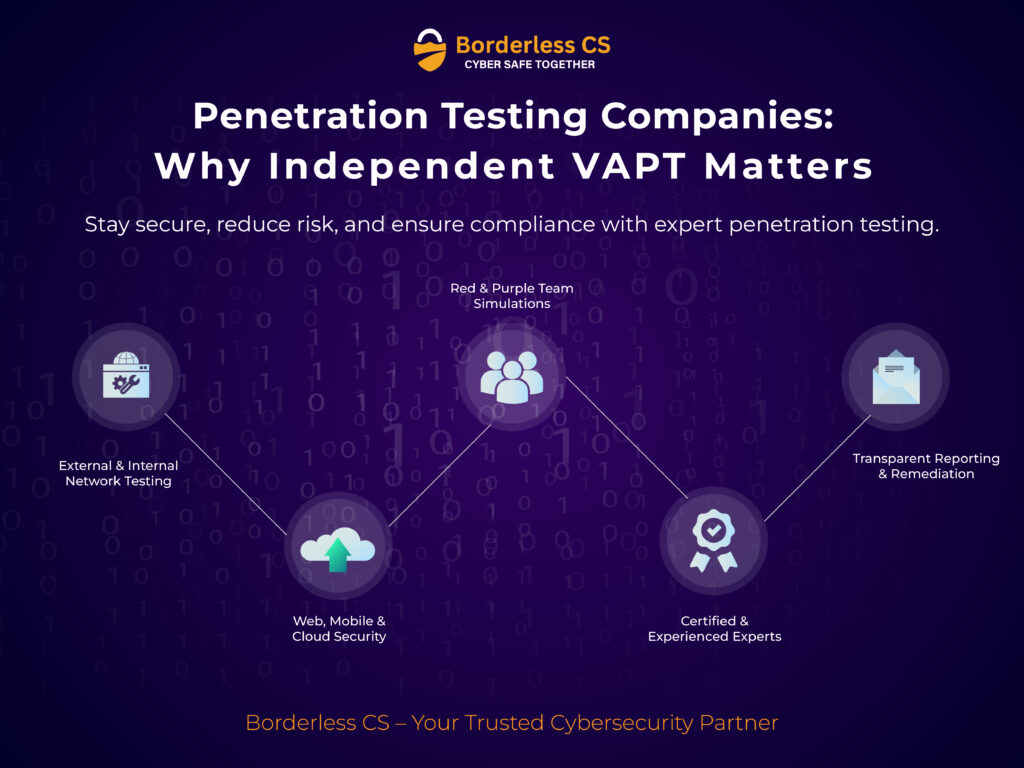
Penetration Testing Companies: Why Independent VAPT Matters More Than Ever
Introduction
Cyberattacks continue to rise across Australia and the Pacific, with small, medium, and large organisations becoming regular targets of ransomware, credential theft, supply-chain compromise, and API exploitation. As a result, penetration testing companies like Borderless CS have become essential partners in maintaining strong cyber resilience.
Choosing the right provider is critical. A skilled penetration testing partner helps organisations identify vulnerabilities early, improve their security posture, and demonstrate compliance with recognised standards such as the Essential Eight, ISO 27001, NIST CSF 2.0, and industry-specific regulations.
This guide explains what penetration testing companies do, how to choose the right partner, and the key features to look for in a high-quality VAPT service.
What Do Penetration Testing Companies Offer?
1. External Network Penetration Testing
This assesses your internet-facing systems to identify vulnerabilities such as misconfigurations, outdated software, weak encryption, and exposure to known exploits.
Key outcomes:
- Reduced attack surface
- Validation of firewall and perimeter controls
- Early detection of high-risk exposures
2. Internal Network Penetration Testing
Simulates an insider threat or an attacker who has breached the perimeter.
Focus areas include:
- Network segmentation weaknesses
- Lateral movement pathways
- Privilege escalation opportunities
- AD (Active Directory) misconfigurations
3. Web & Mobile Application Penetration Testing
Good penetration testing companies follow:
- OWASP Top 10
- API Security Top 10
- Business logic abuse pathways
- Authentication & session management flaws
4. Cloud Penetration Testing
With most organisations now relying on AWS, Azure, or Google Cloud, cloud-specific testing is non-negotiable.
Key focus areas:
- IAM misconfigurations
- Logging gaps
- Serverless/API exposure
- S3/Azure Blob misconfiguration
- Publicly exposed cloud assets
5. Red Teaming / Purple Teaming
Advanced simulation of real-world threat actors, focusing on:
- Initial access
- Detection evasion
- Persistence
- Exfiltration
- Organisational detection and response maturity
- Collaboration between offensive (red) and defensive (blue) teams
How to Choose the Right Penetration Testing Company (Borderless CS)
Selecting the right partner goes beyond price. Organisations should look for:
1. Recognised Certifications
Top penetration testing providers demonstrate credible competence through certifications such as:
- CREST ANZ / CREST International
- ISO/IEC 27001:2022
- SOC 2 Type II
- OSCP, OSCE, OSEP, CISSP
- Vendor accreditations (AWS/Azure Security)
2. Proven Experience
Evidence of testing across sectors such as:
- Healthcare
- Financial services
- Telecommunications
- Government
- Education
- Utilities & critical infrastructure
3. Clear Testing Methodology
The provider should use industry-recognised frameworks such as:
- OWASP Testing Guide
- PTES
- NIST 800-115
- Essential Eight maturity alignment
4. Transparent Reporting
A good VAPT report includes:
- Executive summary
- Technical findings
- Proof-of-Concept (PoC)
- Risk ratings & CVSS scoring
- Remediation guidance
- Retesting support
5. Strong Post-Engagement Support
Look for:
- Free vulnerability retest
- Assurance letter
- Detailed remediation guidance
- Security hardening recommendations
Why Independent Penetration Testing Matters
Independent testers help organisations avoid blind spots. Vendor-neutral penetration testers bring:
- Unbiased findings
- A broader view of risks across industries
- Transparent methodologies
- Documentation that satisfies auditors, insurers, and regulators
This independence also helps satisfy compliance obligations under:
- Essential Eight
- APRA CPS 234
- Australian Privacy Act 1988
- ISO 27001
- PCI DSS v4.0
Conclusion
Penetration testing companies like Borderless CS play a vital role in helping organisations stay secure, compliant, and resilient against constantly evolving cyber threats. By choosing a certified, experienced, and methodology-driven provider, businesses can significantly reduce risk while strengthening trust with regulators, partners, and customers.
Penetration Testing FAQs
How often should penetration testing be performed?
Most organisations conduct penetration testing annually or after significant system changes, cloud migrations, or security incidents.
What does a penetration testing report include?
A detailed report covering vulnerabilities, risk severity, exploitation evidence, and remediation recommendations.
Is penetration testing required for compliance?
Yes. Many standards including ISO 27001, PCI-DSS, Essential Eight, and NIST require regular penetration testing.
What is penetration testing?
Penetration testing (or “pen testing”) is an authorised, ethical hacking exercise where skilled security professionals simulate real-world cyberattacks against your systems, applications, networks, cloud environments, and infrastructure to uncover vulnerabilities before malicious actors do.
Why does my organisation need penetration testing?
Penetration testing helps you:
✔ Identify critical security vulnerabilities before attackers do
✔ Validate the effectiveness of your security controls
✔ Demonstrate reasonable security effort for regulators and insurers
✔ Reduce the risk of breaches, data loss, and service disruption
✔ Support compliance with industry standards like ISO 27001, PCI-DSS, Essential Eight, and NIST frameworks
How long does a penetration test take?
There’s no one-size-fits-all duration — the time depends on the scope of the engagement, the complexity of your environment, and specific goals. Simple assessments may take a few days, whereas large, multi-system engagements can take several weeks.
Is penetration testing required for ASD Essential Eight compliance?
Yes. Penetration testing supports multiple ASD Essential Eight maturity levels by identifying exploitable weaknesses that attackers could leverage.
Do you provide CREST or government-aligned penetration testing?
Our penetration testing approach aligns with Australian government and enterprise security expectations and compliance frameworks.
What systems can be tested during a penetration test?
We test networks, web applications, APIs, cloud environments (Azure/AWS), Microsoft 365, and internal systems.
Does penetration testing support compliance?
Yes. Our testing helps organisations meet CREST ANZ, ISO 27001, PCI-DSS, ASD Essential Eight, and NIST compliance requirements.
