


Advanced Endpoint Protection: Why Every Business Needs More Than Basic Antivirus
Objective
This guide explains what endpoint protection actually covers, why basic antivirus is no longer enough on its own, and what advanced endpoint protection and a managed endpoint protection service add — so you can judge whether your business is properly covered.
Key Takeaways
- Basic antivirus relies on known-signature detection and misses fileless malware, zero-day exploits, and living-off-the-land attacks.
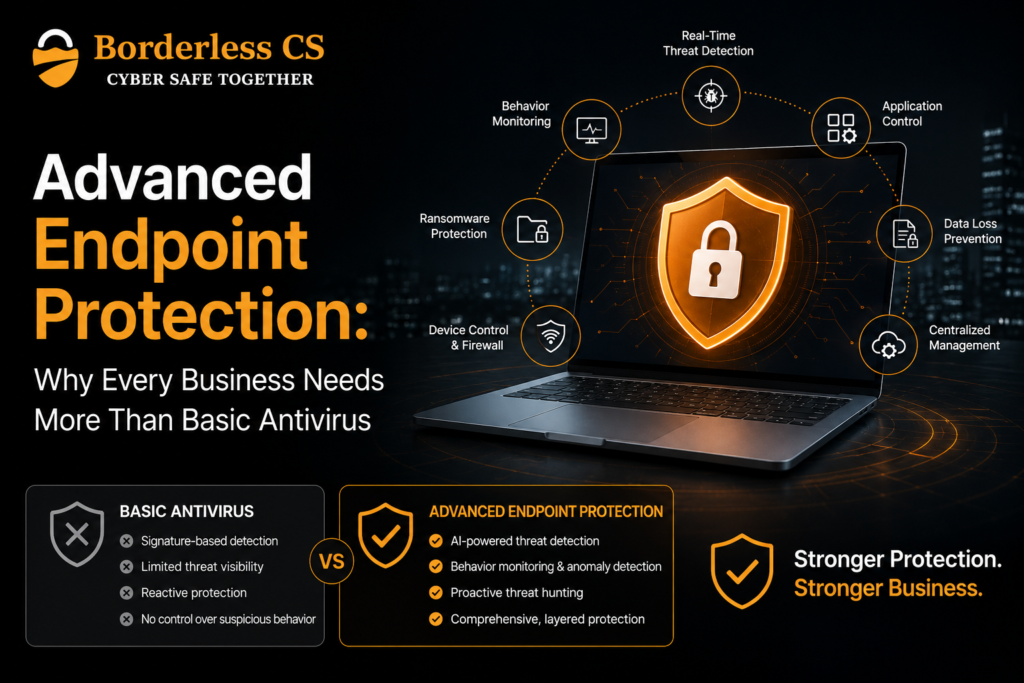
- Advanced endpoint protection combines EDR, behavioural analysis, and automated containment to catch what signature-based tools cannot.
- Remote and hybrid work has expanded the number of unmanaged devices connecting to business networks.
- A managed endpoint protection service adds 24/7 monitoring and expert response most in-house teams can’t staff alone.
- The right endpoint protection service is judged on detection coverage, response speed, and fit with your existing security stack.
Introduction
Every business with a laptop, server, or mobile device connected to its network already runs some form of endpoint protection — even if it’s just the antivirus that shipped with the operating system. That used to be enough. It isn’t anymore. Attackers have moved past the static, signature-based malware antivirus was built to catch, and businesses still relying on it alone are finding the gap the hard way.
Table of Contents
- What Is Endpoint Protection?
- Why Basic Antivirus Isn’t Enough
- What Advanced Endpoint Protection Includes
- Signs You Need an Endpoint Protection Service
- How Borderless CS’s Endpoint Protection Service Works
- Conclusion
- FAQ
What Is Endpoint Protection?
Endpoint protection refers to the security measures applied directly to devices — laptops, desktops, servers, and mobile phones — that connect to a business network. Traditionally this meant antivirus: software that scans files against a database of known malware signatures and blocks matches. That model worked when threats were static files with recognisable signatures. Endpoint protection has since grown into a broader discipline that includes continuous monitoring and behavioural detection, not just file scanning.
Why Basic Antivirus Isn’t Enough
Basic antivirus still has a role, but on its own it leaves real gaps: fileless attacks carried out through legitimate tools like PowerShell, zero-day exploits with no known signature yet, and lateral movement across a network that a single-device scan simply can’t see. Antivirus can flag a known threat, but it rarely investigates or contains an incident — and that gap is where damage accumulates.
What Advanced Endpoint Protection Includes
- EDR (Endpoint Detection and Response): continuous activity recording so unusual behaviour, not just known malware, triggers an alert.
- Behavioural analysis: flagging attacks by what they do, such as mass file encryption or unusual privilege escalation.
- Automated containment: isolating a compromised device the moment suspicious activity is confirmed.
- Centralised visibility: one dashboard showing the security status of every endpoint.
Signs You Need an Endpoint Protection Service
- Remote or hybrid staff connect from personal or unmanaged devices.
- You handle sensitive client, financial, or health data under compliance obligations.
- You’ve had a security incident or near-miss in the past 12 months.
- Your IT team has no capacity to monitor alerts outside business hours.
How Borderless CS’s Endpoint Protection Service Works
Borderless CS runs endpoint protection as a managed, end-to-end service rather than a one-off software install. In practice, that looks like:
- Seamless deployment: rolling out protection across every device with minimal disruption to daily operations.
- Continuous monitoring: watching all endpoints around the clock, not just during business hours.
- Proactive detection: using machine learning and behavioural analysis to catch both known and unknown threats.
- Instant response: automatically isolating and containing a compromised device to limit impact.
- Detailed reporting: giving you visibility into your security posture, not just a list of past alerts.
The service is built on leading platforms — including CrowdStrike Falcon, SentinelOne, and Microsoft’s endpoint security stack among others — matched to what fits your environment rather than a one-size-fits-all deployment.
Conclusion
If your business is still relying on out-of-the-box antivirus, the question isn’t whether that leaves you exposed — it’s how long it takes to find out. Advanced endpoint protection, backed by a managed endpoint protection service, is the difference between discovering an incident after the damage is done and stopping it at the first sign of compromise.
Is antivirus the same as endpoint protection?
No. Antivirus is one component of endpoint protection. Full endpoint protection also includes behavioural detection, EDR, and response capabilities antivirus alone doesn’t provide.
Do small businesses need advanced endpoint protection?
Yes — attackers don’t only target large enterprises, and smaller businesses often have fewer resources to recover from an incident, making early detection more important, not less.
What's the difference between EDR and antivirus?
Antivirus blocks known threats by matching signatures. EDR continuously monitors endpoint behaviour, detecting and responding to threats that have no known signature yet.
Is a managed endpoint protection service worth it over in-house monitoring?
For most businesses, yes — 24/7 monitoring and rapid response require dedicated staffing that few in-house IT teams can sustain alone.