


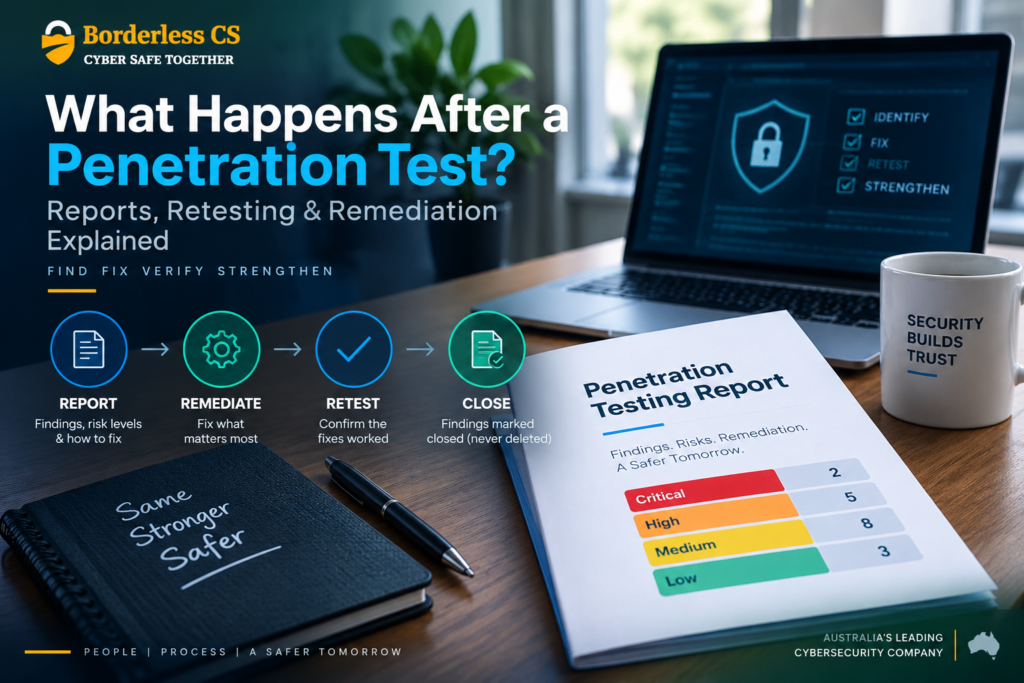
What Happens After a Penetration Testing? Reports, Retesting & Remediation Explained
Quick answer: After a penetration test, you receive a report detailing every vulnerability found, its risk level and how to fix it. Your organisation then owns remediation fixing what matters most first before your provider retests to confirm the fixes actually worked. Only then are findings marked closed, never deleted, which matters if an auditor asks to see the full history later.
Most of the anxiety around penetration testing isn’t about the test itself it’s about what happens next. You’ve paid for penetration testing services, you’ve got a report full of findings, and now what? Can you show this to a customer? How do you actually prove the vulnerabilities are gone? Here’s how the process really works.
What's Actually Inside Your Penetration Testing Report
A proper report isn’t one document written for one audience it’s layered for three different readers:
- Executive summary — for leadership: what was tested, what was found, what it means for the business, in plain language
- Technical findings — for your IT or development team: each vulnerability, how it was found, evidence, and exact remediation steps
- Risk ratings — every finding ranked by severity and real-world exploitability, not just a raw vulnerability count
If your last penetration test report was a wall of CVE numbers with no business context, that’s a sign of a scan-and-report job rather than genuine manual penetration testing services the two are not the same thing, even when different penetration testing companies price them similarly.
Who Is Responsible for Fixing the Vulnerabilities?
This is the single most common point of confusion after a penetration test. Your organisation owns remediation, not your testing provider. Fixes typically split across whoever manages the affected system:
- Infrastructure or IT teams patch servers and fix configurations
- Developers fix insecure application code
- Cloud teams correct permissions, storage exposure and identity misconfigurations
- Third-party vendors fix issues in systems they manage on your behalf
A good penetration testing provider doesn’t disappear after handing over the PDF — they should be available to explain findings, answer questions, and help you prioritise what to fix first versus what can wait.
How Retesting Works (and Why You Shouldn't Skip It)
Once remediation is complete, retesting answers one question: did the fix actually work? Most organisations schedule retesting 2–4 weeks after remediation, giving enough time to apply fixes without leaving vulnerabilities exposed for too long.
A few things people don’t expect:
- Findings are never deleted after a successful retest only marked “closed.” The original finding stays in the report history; this matters if a regulator or auditor later asks for a complete record, not just a clean-looking summary
- Retesting isn’t automated. A vulnerability scanner can confirm some fixes, but it can’t validate business-logic flaws or chained exploits only a human retest can
- If testers can still exploit the original issue, remediation wasn’t successful and needs another pass this isn’t a failure on your part, it’s exactly why retesting exists
Can You Share the Report With Customers or Auditors?
Not directly, in most cases and this trips up a lot of Australian businesses under time pressure from a tender or audit deadline. A full technical report contains exploit details you generally don’t want circulating. Instead, most penetration testing companies in Australia issue a Letter of Attestation a short, formal document confirming the test occurred, summarising scope and overall risk posture, without exposing exploitable detail.
This is the document that actually satisfies most Australian compliance and procurement requests cyber insurance renewals, ISO 27001 audits, APRA CPS 234 evidence requests, and tender security questionnaires all typically ask for attestation-level evidence, not the raw technical report.
Why Choose Borderless CS
A lot of penetration testing companies treat the engagement as finished the moment the report is sent. Borderless CS doesn’t work that way:
- Retesting included as standard, not billed as a separate add-on after the fact
- A Letter of Attestation with every engagement ready for insurers, auditors, tenders and customer security questionnaires without extra back-and-forth
- Australian-based consultants across Melbourne, Sydney and Brisbane who explain findings in plain language, not just hand over a PDF
Dual CREST-accredited (ANZ and International) one of the few penetration testing firms in Australia holding both so remediation guidance follows recognised methodologies your auditors will recognise too
If you’re comparing penetration testing companies in Australia, ask specifically whether retesting and attestation are included not every penetration testing provider bundles both in as standard.
Contact Borderless CS:
- Book a Free Scoping Call
- Request a Proposal
- Download Borderless CS’s Penetration Testing Brochure
Build a Strong Cybersecurity Strategy Today
Cyber threats are evolving, targeting businesses of every size. Combining:
- Managed Security Services
- Penetration Testing
- SOC Monitoring
- Cloud Security
creates a resilient cybersecurity strategy. Protect your business, maintain regulatory compliance, and secure your future with Borderless CS.
This article was reviewed by cybersecurity professionals experienced in penetration testing, compliance frameworks, and Australian cyber security regulations.
Frequently Asked Questions
1. Do I have to fix every finding in a penetration test report?
Not necessarily all at once. Prioritise by severity and real-world exploitability first critical and high-risk findings first, lower-risk items can often wait for a scheduled maintenance window.
2. How soon after remediation should retesting happen?
Most Australian organisations retest 2–4 weeks after remediation is complete, though timing can be adjusted for urgent, high-severity findings — confirm your provider’s standard turnaround when scoping penetration test services.
3. Is a penetration test report enough for ISO 27001 or APRA CPS 234 compliance?
Usually the Letter of Attestation, not the full technical report, is what auditors and regulators expect to see as evidence of penetration testing services delivered.
4. What if retesting shows the vulnerability is still there?
That finding stays open and remediation continues it isn’t a failed engagement, it’s exactly what retesting is designed to catch before it becomes a real incident.
Not sure what to do with your last pentest report, or ready to book your next round of pentesting services? Book a free 30-minute consultation with Borderless CS.
Speak with Borderless CS about ISO 27001 and ISO 42001 readiness and certification support.