


Choosing Between Penetration Testing Companies in Australia? Here Is Why CREST Accreditation Should Top Your Checklist
In this article
- What is CREST, and why does it matter?
- A penetration test is not a vulnerability scan
- What a CREST accredited engagement looks like
- The full breadth of a modern attack surface
- Recognition from CREST
- Part of a bigger commitment to trust
- How to shortlist penetration testing companies in Australia
- Frequently asked questions
Search for penetration testing companies in Australia and you will find dozens of providers, all promising the same thing: to find your weaknesses before attackers do. From the outside, they can look almost identical. So how do you separate the firms that will actually reduce your risk from the ones that will hand you a scanner report and an invoice?
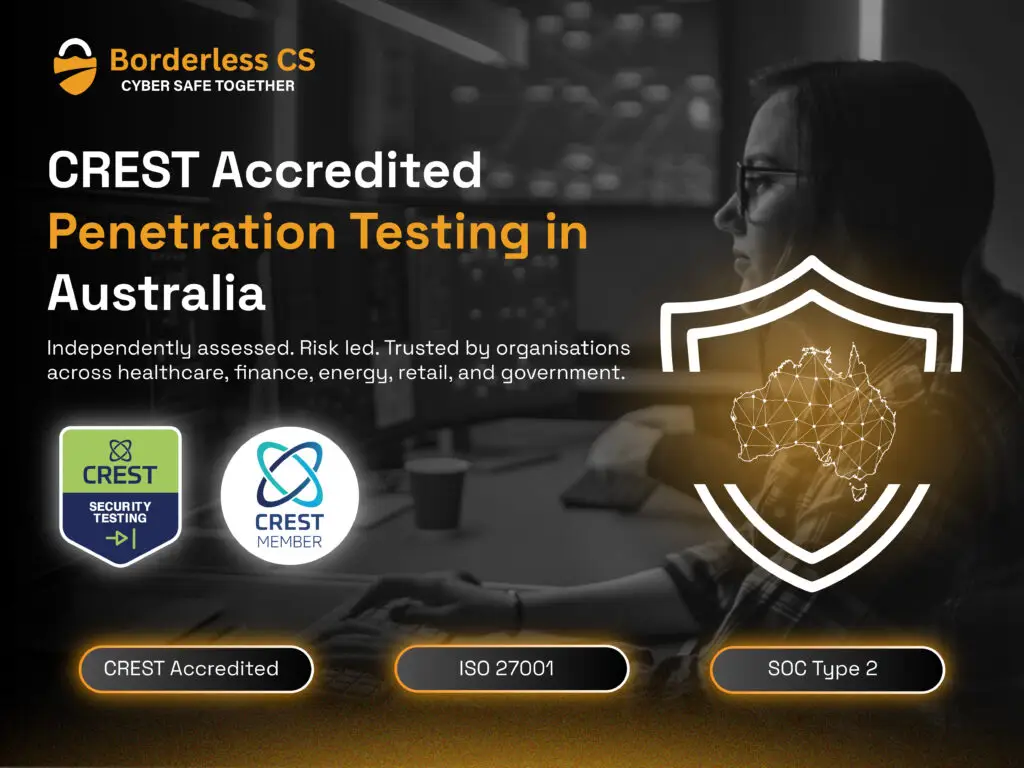
Our answer is simple: start with CREST accreditation. It has now been two years since Borderless CS earned CREST (International) accreditation for penetration testing, and the milestone feels worth pausing on. Not because a certificate on the wall matters in itself, but because of what those two years have looked like in practice: engagement after engagement delivered to the same independently assessed standard, for organisations that needed real answers about their security.
What is CREST, and why does it matter?
CREST is a not for profit body established in the UK in 2006 to raise standards across the global cybersecurity profession. It provides accreditation frameworks, certification pathways, and professional development support in markets around the world, and its stamp of approval has become one of the most trusted signals in the industry. Many government agencies, banks, and large enterprises will not engage a penetration testing provider unless that provider is CREST accredited.
The reason is simple. Anyone can buy a scanning tool, run it against your network, and hand over a PDF. CREST accreditation is evidence of something much harder to fake: that a company tests in a way that is consistent, ethical, secure, and repeatable, every single time, regardless of which consultant is on the job. Among the many penetration testing companies in Australia, only a small group have put themselves through that level of independent scrutiny.
To earn and hold the accreditation, Borderless CS is assessed against CREST’s internationally recognised requirements. The review covers our operating procedures, the security vetting of our people, how we protect the sensitive data clients share with us, and the methodologies we use to plan, deliver, and report penetration testing engagements. Nothing is taken on trust. Everything is evidenced. You do not have to take our word for it either: any provider claiming accreditation should appear in the official CREST approved companies directory, and we encourage you to check.
A penetration test is not a vulnerability scan

What a CREST accredited engagement looks like
Two years of delivering to the CREST standard has shaped every stage of how we work:
- We start by understanding your environment, your risk appetite, and what you actually need answered, so the test targets what matters instead of ticking a box.
- Engagements are delivered by vetted, experienced consultants following documented, repeatable methodologies, with clear rules of engagement and secure handling of your data throughout.
- You receive an executive summary written for decision makers and detailed technical findings written for the people who will do the fixing, with remediation prioritised by real business risk.
- Support after the report. We walk your team through the findings, answer questions, and offer retesting to confirm the fixes have closed the gaps.
The full breadth of a modern attack surface
Our CREST accredited penetration testing services cover:
- Network and infrastructure penetration testing
- Web application and API testing
- Mobile application penetration testing
- Cloud security testing
- Social engineering and phishing simulations
- Red teaming
- IoT penetration testing
Every engagement is risk led. We do not just tell you what is broken. We tell you what it means for your business, which findings actually matter, and how to fix them in an order that reduces real risk fastest.
Recognition from CREST
When the accreditation was awarded, Nigel Phair, Regional Director (APAC) at CREST, congratulated the team, noting that the achievement “reflects the team’s commitment to robust business processes, secure data handling and consistent testing methodologies.”
Two years on, those words describe standards we work to every day, on every engagement, because accreditation is not a one off exam. It is a bar you keep clearing.
Part of a bigger commitment to trust
CREST accreditation sits alongside a set of credentials we have built deliberately over the years, including ISO 27001, ISO 9001, ISO 45001, SOC 2 Type 2, and GDPR compliance. Together, they reflect how seriously we take the responsibility our clients place in us, whether they operate in healthcare, financial services, energy, retail, or government. You can see how that plays out in practice in our client success stories, including engagements with local government, healthcare, and financial services organisations.
From our headquarters in Melbourne and our offices in Sydney, Brisbane, and Fiji, our team delivers penetration testing alongside managed security services, incident response, digital forensics, threat intelligence, cloud security, endpoint security, identity and access management, operational technology security, and governance, risk and compliance support.
How to shortlist penetration testing companies in Australia
When you are comparing providers, we suggest asking five questions. Is the company CREST accredited, and can it show current certificates for its wider management systems? Are its consultants employees who have been security vetted, or subcontractors? Will the report include business impact and prioritised remediation, or just raw findings? Does the engagement include a debrief and retesting? And can the provider point to experience in your industry?
Ask those questions of any firm on your shortlist, including us. A provider that meets the bar will welcome them.
Why Is Penetration Testing Important?
Cybersecurity is no longer just an IT issue—it is a business risk.
A successful cyberattack can lead to:
- Business disruption
- Financial losses
- Data breaches
- Regulatory penalties
- Loss of customer trust
- Reputational damage
Many businesses believe that having antivirus software and firewalls is enough. While these controls are essential, they don’t guarantee that vulnerabilities don’t exist.
Penetration testing validates whether your existing security controls are actually protecting your organisation against realistic attack scenarios.
Vulnerability Scanning vs Penetration Testing
Many people assume vulnerability scanning and penetration testing are the same. They are not.
| Vulnerability Scanning | Penetration Testing |
|---|---|
| Automated process | Manual and automated testing |
| Identifies known vulnerabilities | Demonstrates how vulnerabilities can be exploited |
| Generates a list of issues | Validates real business risk |
| Limited context | Provides detailed remediation advice |
A vulnerability scan might identify hundreds of potential issues, but a penetration test helps determine which ones present genuine security risks.

Final Thoughts
If it has been more than a year since your last penetration test, if a regulator, insurer, or major customer is asking for evidence of CREST accredited testing, or if your last report left you with more questions than answers, we would love to show you what two years of CREST accredited practice looks like on your environment.
Get in touch with the Borderless CS team today to scope your next penetration test.
Contact Borderless CS:
- Book a Free Scoping Call
- Request a Proposal
- Download Borderless CS’s Penetration Testing Brochure
Build a Strong Cybersecurity Strategy Today
Cyber threats are evolving, targeting businesses of every size. Combining:
creates a resilient cybersecurity strategy. Protect your business, maintain regulatory compliance, and secure your future with Borderless CS.
Trusted Cybersecurity Services for Australian Organisations
Borderless CS helps Australian organisations prevent cyber attacks, respond to incidents, and strengthen cyber resilience.
Whether you require a fully managed SOC, penetration testing, or cybersecurity compliance support, we deliver services that stand up to scrutiny.
No offshoring. No shortcuts. No ambiguity.
Book a Free Cyber Risk Assessment
Speak with an Australian cybersecurity consultant and gain a clear understanding of your organisation’s cyber risk posture.
Book a free, no-obligation cyber risk assessment and receive practical recommendations aligned to Australian cybersecurity frameworks.
📧 Email: [email protected]
🌐 Website: https://borderlesscs.com.au
Why Businesses Choose Borderless CS
We help organisations strengthen their cybersecurity posture through advanced testing and security services. Our experts deliver comprehensive penetration testing Australia solutions designed to simulate real-world cyberattacks and uncover hidden vulnerabilities.
In addition to penetration testing, we provide vulnerability assessments, cloud security testing, and ongoing monitoring services to protect businesses against evolving threats.
Businesses can also integrate our testing services with our Security Operations Center (SOC) for continuous threat monitoring and incident response.
Learn more about our services:
- Penetration Testing Services
https://borderlesscs.com.au/penetration-testing/
- SOC Monitoring
https://borderlesscs.com.au/managed-security-services/
- Managed Security Services
https://borderlesscs.com.au/managed-security-services/
If your business wants to identify exploitable vulnerabilities, professional penetration testing services Australia can help simulate real cyberattacks and uncover hidden risks. Learn more about our Penetration Testing Services.
Secure Your Business with Borderless CS
Cyber threats won’t wait. Neither should your protection.
🌐 Website: https://borderlesscs.com.au
📧 Email: [email protected]
This article was reviewed by cybersecurity professionals experienced in penetration testing, compliance frameworks, and Australian cyber security regulations.
Frequently Asked Questions
1. What is penetration testing?
Penetration testing is a controlled cybersecurity assessment where ethical hackers simulate real-world attacks to identify and validate security vulnerabilities.
2. How is penetration testing different from vulnerability scanning?
Vulnerability scanning identifies potential security issues using automated tools, while penetration testing confirms whether those vulnerabilities can be exploited and assesses their real business impact.
3. How long does a penetration test take?
The duration depends on the scope. Smaller assessments may take a few days, while larger or more complex environments can take one to three weeks.
4. Is penetration testing required for compliance?
Many standards and regulations, including PCI DSS, ISO 27001, and APRA CPS 234, either require or strongly recommend regular penetration testing as part of a comprehensive security program.
5. Can penetration testing disrupt business operations?
Professional penetration testing is carefully planned and performed within agreed rules of engagement to minimise disruption. High-risk testing is often scheduled outside normal business hours.
6. What's the difference between a vulnerability scan and a penetration test?
A vulnerability scan is automated and tells you what might be wrong. A penetration test has a skilled human safely exploiting those weaknesses to show you what an attacker could actually do. Scans are a starting point; real penetration testing companies do the manual work that follows.
7. Is Borderless CS CREST accredited?
Yes. Borderless CS is accredited under both CREST ANZ and CREST International — one of the few Australian firms to hold both — and our CEO serves on the board of CREST Australia New Zealand.
About the author
JP Muthusamy is the Founder and CEO of Borderless CS, a CREST accredited cybersecurity company headquartered in Melbourne with offices in Sydney, Brisbane, and Fiji. He leads teams delivering penetration testing, managed security services, incident response, and cyber assurance to organisations across healthcare, financial services, energy, retail, and government. Borderless CS holds CREST accreditation for penetration testing alongside ISO 27001, ISO 9001, ISO 45001, SOC 2 Type 2, and GDPR compliance. Connect with JP on LinkedIn or learn more at borderlesscs.com.au.